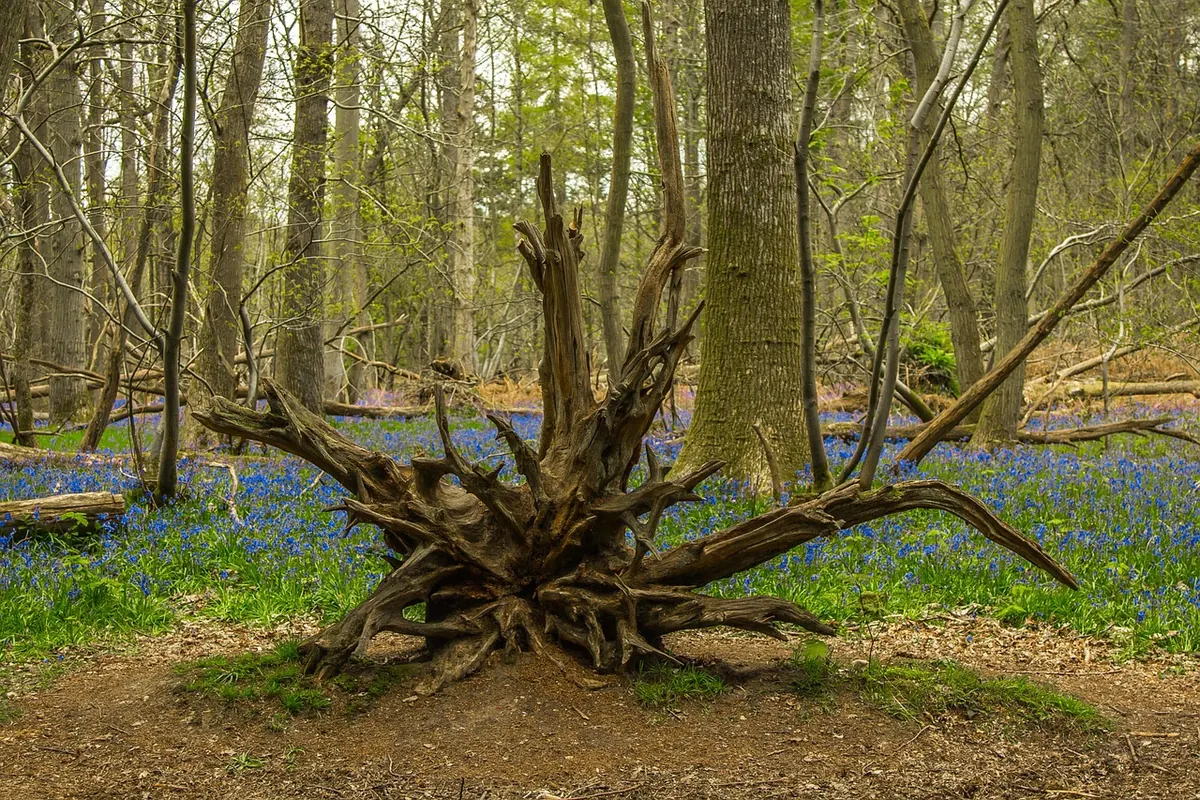
There's a particular smell to a bluebell wood in late April: damp leaf litter, cold soil, and something faintly sweet underneath. Then the light comes through fresh beech leaves, the whole floor turns blue, and it becomes very easy to forget where you're putting your feet. That's the tension at the heart of bluebell photography. The best pictures usually come from ground level, in among the flowers — which is exactly where you shouldn't be. The good news is that the most careful approach also tends to produce the better frame.
Bluebells are slow. A colony takes years to establish, and a single afternoon of trampling can flatten stems that won't recover that season. Beneath the surface the bulbs are already storing energy for next spring, and compacted soil makes that harder. Many British woods also hold hybrids with garden Spanish bluebells, which dilute the native population — so a wood worth photographing is a wood worth protecting.
Fragile flowers, and rules worth knowing
In the UK, uprooting wild plants without the landowner's permission is an offence, and bluebells are among the species given extra legal protection. Set that alongside the plain ecology of the thing and the conclusion is simple: take the photograph, leave the flower. If you want bluebells in your own garden, buy cultivated bulbs from a reputable supplier rather than helping yourself to anything growing wild.
- Stay on paths and bare ground, and set your tripod on the path edge rather than in the flowers.
- Don't kneel, sit or lie in a bluebell bed, and never put a bag down on one. Stems bend and don't spring back.
- Keep dogs and children on the path during the flowering weeks.
- On reserves, follow the site's own rules. Many ask visitors to keep to main paths in May.
- If a wood is private, ask the landowner or your local wildlife trust. A polite request and an offer to visit on a quiet weekday often gets a yes.
Pick the right wood, and the right week
Bluebells move north and uphill through spring. The south-west and southern England flower first, then the Midlands, then northern England, with Scotland and higher ground following later. Two woods a few miles apart can be a week or more apart, depending on slope and shelter. A south-facing bank will always be ahead of a shaded one.
That's why local reports beat any calendar. Check a wildlife trust or Woodland Trust page for the area, ask in a local photography group, or visit the week before and look at the buds. You want the first flush of full flower — vivid blue, upright stems — not the tired grey-purple of a colony going over.
Go on a weekday, and go early. Popular woods within an hour of a city can be busy by mid-morning at the weekend, and people in the frame are harder to remove than a stray branch. First light gives you still air, soft light and no crowds.
Get low, but stay off the flowers
The classic mistake is to point a wide lens down a path and hope the blue reads. It usually doesn't. You get a thin ribbon of colour along the bottom of the frame and a lot of dull trunks above it.
Shoot across the drift, not along it
Drop the tripod to 20–40cm — most go lower than people expect if you splay the legs — and compose across the flowers instead of down the path. From that height, a clump a metre away fills the foreground and the drift behind it falls into a soft blue haze. Your knees never leave the path edge.
Try a longer lens
A 70–200mm at around 150mm compresses a whole slope into layered bands of blue and green. It is often more convincing than the wide view, and it lets you work from further back — better for the flowers, easier for you.
Look for contrast and edges: pale birch trunks against blue, the ragged boundary of a drift meeting last year's bracken, a single white or pink bluebell standing out of the crowd. Keep the sky out of the frame unless you've decided it belongs there; a sliver of white at the top usually just pulls the eye away from the floor.
Light: overcast days beat sunshine
Bluebell woods are dark places. Under a closed canopy you may be working at f/8, ISO 800 and half a second, while midday sun through leaves throws dappled patches that blow out to white and leave everything else black.
- Overcast, misty or showery weather gives an even wash of light that lets blue hold its colour.
- If the sun is out, work in shade or wait for cloud. Sunbeams can be lovely, but expose for them and let the rest of the frame fall dark.
- Backlight a single flower head against a dark trunk and it will glow. That's a better use of sunshine than a wide sunlit shot.
- Watch white balance. Auto often turns blue
Photo: diego_torres / Pixabay